The Silent Siege of the Sands
Buried by the Dunes: The Relentless Advance of Desertification in Vulnerable Regions
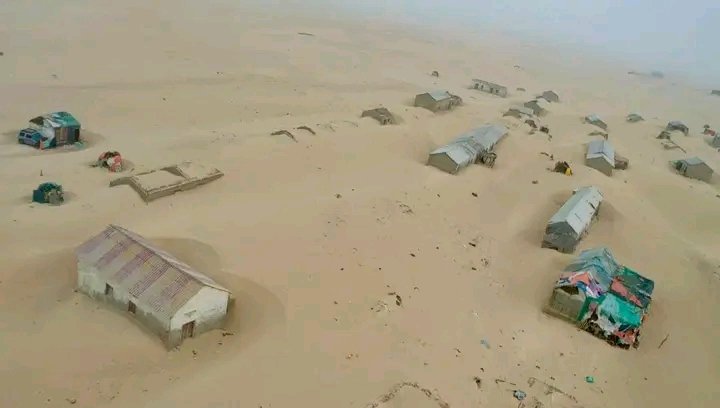
The image presents a haunting landscape where the boundary between human settlement and the encroaching desert has collapsed. Viewed from above, the scene shows a cluster of permanent and semi-permanent structures—homes that were once centers of daily family life—now fighting a losing battle against nature. Massive drifts of pale sand have piled up against walls and over roofs, swallowing entire sections of the village. The stark beige monochrome of the sand contrasts with the fading colors of the rooftops, symbolizing the overwhelming power of the environment over the built infrastructure.
The Human Impact This is not a disaster that strikes in a moment, like a flash flood; it is a creeping crisis. The image represents "climate shock" in its most tangible form. For the families who lived here, this signifies total displacement—not just the loss of a house, but the loss of arable land, livestock grazing areas, and a sense of belonging. It highlights the plight of "climate-affected rural and peri-urban populations", who are often forced to migrate as their homes become uninhabitable. The absence of visible activity suggests that many may have already been forced to flee, leaving their investments and history behind in the dunes.
The Call for Resilience This scene is the primary driver for Raad Society’s Thematic Area C: Climate Adaptation & Resilience. It validates the necessity of Strategic Objective 3: "Strengthen community capacity to adapt to climate and environmental shocks".
To prevent more villages from becoming ghost towns buried in sand, interventions must go beyond emergency aid. They require long-term solutions such as:
Environmental Restoration: Planting green belts to stabilize soil and stop sand encroachment.
Climate-Smart Management: Teaching communities how to manage land to prevent degradation before it reaches this irreversible point.
Resilience Building: Empowering communities to withstand these shocks so that "Leaving a Footprint of Hope" means leaving a footprint that the wind cannot blow away.